This notebook solves a small graph of noncommuting three-dimensional rotations with GTSAM’s Burer–Monteiro Riemannian Staircase. It illustrates the same certifiable pipeline as the planar example while starting at rank three and rounding matrix variables.

import time

import matplotlib.pyplot as plt
import numpy as np

import gtsam
from gtsam.symbol_shorthand import X

np.set_printoptions(precision=4, suppress=True)
rng = np.random.default_rng(7)
Noncommuting rotations with loop closures
The ground-truth orientations combine roll, pitch, and yaw, so they do not stay inside a common one-dimensional subgroup. Consecutive edges form a cycle and three additional loop closures constrain the graph. For every edge, the exact relative measurement is .
num_rotations = 5
ground_truth = [
    gtsam.Rot3.RzRyRx(0.16 * index, -0.10 * index, 0.13 * index)
    for index in range(num_rotations)
]
edges = [
    (0, 1), (1, 2), (2, 3), (3, 4), (4, 0),
    (0, 2), (1, 3), (2, 4),
]

graph = gtsam.NonlinearFactorGraph()
for source, target in edges:
    graph.add(
        gtsam.FrobeniusBetweenFactorRot3(
            X(source),
            X(target),
            ground_truth[source].between(ground_truth[target]),
        )
    )

initial = gtsam.Values()
initial_matrices = []
for index, rotation in enumerate(ground_truth):
    tangent_perturbation = rng.normal(scale=0.10, size=3)
    perturbed = rotation.compose(gtsam.Rot3.Expmap(tangent_perturbation))
    initial_matrices.append(perturbed.matrix())
    initial.insert(X(index), perturbed.matrix().T)

print(f"{graph.size()} relative-rotation factors, {initial.size()} variables")
8 relative-rotation factors, 5 variables
Run and certify the rank-three relaxation
The local augmented-Lagrangian solver enforces the quadratic orthogonality constraints. The outer staircase verifies the SDP certificate and lifts the factorization rank only when necessary.
alm_params = gtsam.AugmentedLagrangianParams()
alm_params.maxIterations = 100
alm_params.absoluteViolationTolerance = 1e-8

params = gtsam.RiemannianStaircaseParams()
params.pMin = 3
params.pMax = 5
params.eta = 1e-3
params.setAlmParams(alm_params)

start = time.perf_counter()
result = gtsam.RiemannianStaircaseOptimizer(graph, initial, params).optimize()
wall_time = time.perf_counter() - start

print(f"Certified: {result.certified}")
print(f"Final rank: {result.finalRank}")
print(f"Certificate lower bound / minimum eigenvalue: {result.minEigenvalue:.3e}")
print(f"Solver time: {result.totalTime:.3f} s; notebook wall time: {wall_time:.3f} s")
Certified: True
Final rank: 3
Certificate lower bound / minimum eigenvalue: -1.000e-03
Solver time: 0.001 s; notebook wall time: 0.001 s
Round, project, and fix the global gauge
The rank-three QCQP blocks store and share an gauge. We first choose a consistent determinant sign, transpose and project every block to the closest proper rotation with SVD, and then apply one common left rotation so the first estimate matches the first ground-truth orientation.
if not result.hasRoundedSolution():
    raise RuntimeError("The staircase did not return a rounded solution.")

def project_to_so(matrix):
    """Return the closest proper rotation to a square matrix."""
    left, _, right_transpose = np.linalg.svd(matrix)
    correction = np.eye(matrix.shape[0])
    correction[-1, -1] = np.linalg.det(left @ right_transpose)
    return left @ correction @ right_transpose

rounded_values = result.roundedValues()
rounded_blocks = [rounded_values.atMatrix(X(i)).copy() for i in range(num_rotations)]
if sum(np.linalg.det(block) < 0.0 for block in rounded_blocks) > num_rotations // 2:
    for block in rounded_blocks:
        block[:, -1] *= -1.0

rounded_rotations = [project_to_so(block.T) for block in rounded_blocks]
truth_matrices = [rotation.matrix() for rotation in ground_truth]

def gauge_align(rotations, reference):
    gauge = reference[0] @ rotations[0].T
    return [gauge @ rotation for rotation in rotations]

initial_aligned = gauge_align(initial_matrices, truth_matrices)
rounded_aligned = gauge_align(rounded_rotations, truth_matrices)

def rotation_error_degrees(estimate, truth):
    relative = truth.T @ estimate
    cosine = np.clip((np.trace(relative) - 1.0) / 2.0, -1.0, 1.0)
    return np.rad2deg(np.arccos(cosine))

initial_error = np.array([
    rotation_error_degrees(estimate, truth)
    for estimate, truth in zip(initial_aligned, truth_matrices)
])
rounded_error = np.array([
    rotation_error_degrees(estimate, truth)
    for estimate, truth in zip(rounded_aligned, truth_matrices)
])

print(f"Maximum initial orientation error: {initial_error.max():.3f} deg")
print(f"Maximum rounded orientation error: {rounded_error.max():.3e} deg")
Maximum initial orientation error: 7.601 deg
Maximum rounded orientation error: 0.000e+00 deg
indices = np.arange(num_rotations)
width = 0.36
fig, axis = plt.subplots(figsize=(8, 4))
axis.bar(indices - width / 2, initial_error, width, label="initial")
axis.bar(indices + width / 2, rounded_error, width, label="rounded")
axis.set(
    xlabel="rotation index",
    ylabel="geodesic orientation error (deg)",
    title="Orientation error after gauge alignment",
    xticks=indices,
)
axis.grid(axis="y", alpha=0.3)
axis.legend()
plt.tight_layout()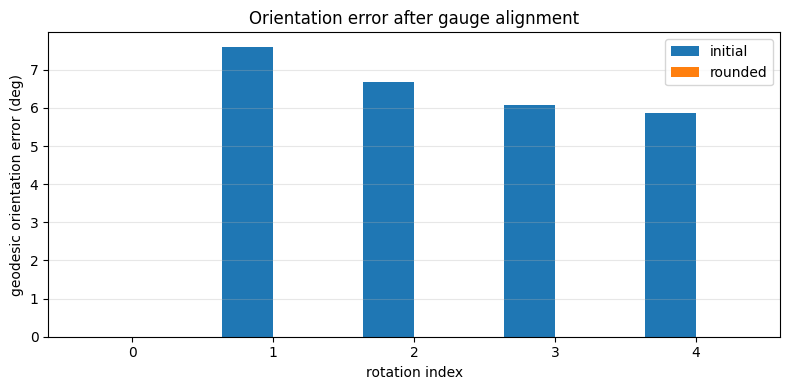
ranks = np.asarray(result.getRanksVisited())
costs = np.asarray(result.getCostPerLevel())
eigenvalues = np.asarray(result.getMinEigenvaluePerLevel())
build_times = np.asarray(result.getQcqpBuildTimePerLevel())
nlp_times = np.asarray(result.getNlpTimePerLevel())
verify_times = np.asarray(result.getVerifyTimePerLevel())

fig, axes = plt.subplots(1, 3, figsize=(13, 3.5))
axes[0].plot(ranks, costs, "o-")
axes[0].set(xlabel="staircase rank", ylabel="cost", title="Objective")
axes[1].plot(ranks, eigenvalues, "o-")
axes[1].axhline(-params.eta, color="tab:red", linestyle="--", label="$-\\eta$")
axes[1].set(xlabel="staircase rank", ylabel="eigenvalue / lower bound", title="Certificate")
axes[1].legend()
axes[2].bar(ranks, build_times, label="QCQP build")
axes[2].bar(ranks, nlp_times, bottom=build_times, label="local solve")
axes[2].bar(ranks, verify_times, bottom=build_times + nlp_times, label="verification")
axes[2].set(xlabel="staircase rank", ylabel="seconds", title="Runtime by level")
axes[2].legend()
for axis in axes:
    axis.grid(alpha=0.3)
plt.tight_layout()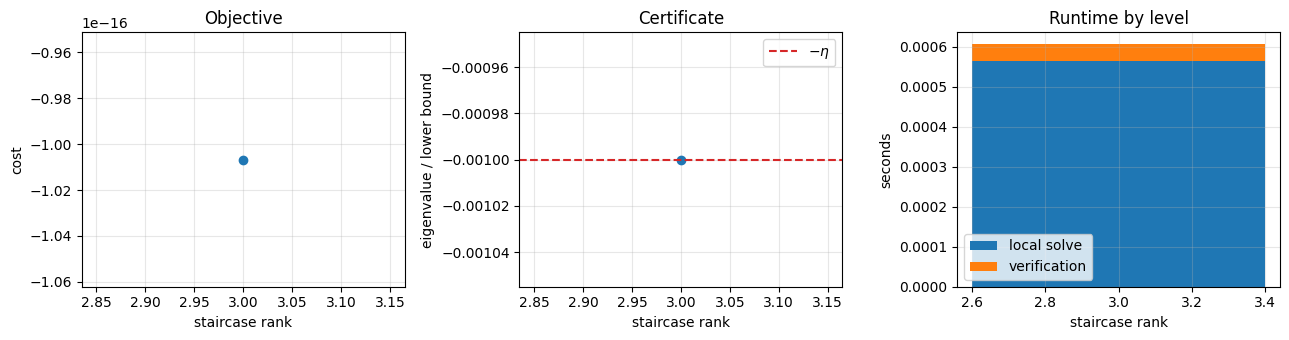
The rank-three factorization is sufficient for this graph, and the certificate verifies the SDP relaxation at that level. Projection and gauge alignment convert the generic matrix-valued result into directly interpretable orientations.